Free World Cup Sweepstake Template You Can Print Right Now
Most sweepstake templates you find online either need an email sign-up, come plastered in watermarks, or fall apart the moment you try to print them. This one does none of that. Below you'll find a straightforward, print-ready World Cup sweepstake template that works for offices, households, and group chats alike, plus honest guidance on picking the right format for your group before the draw.
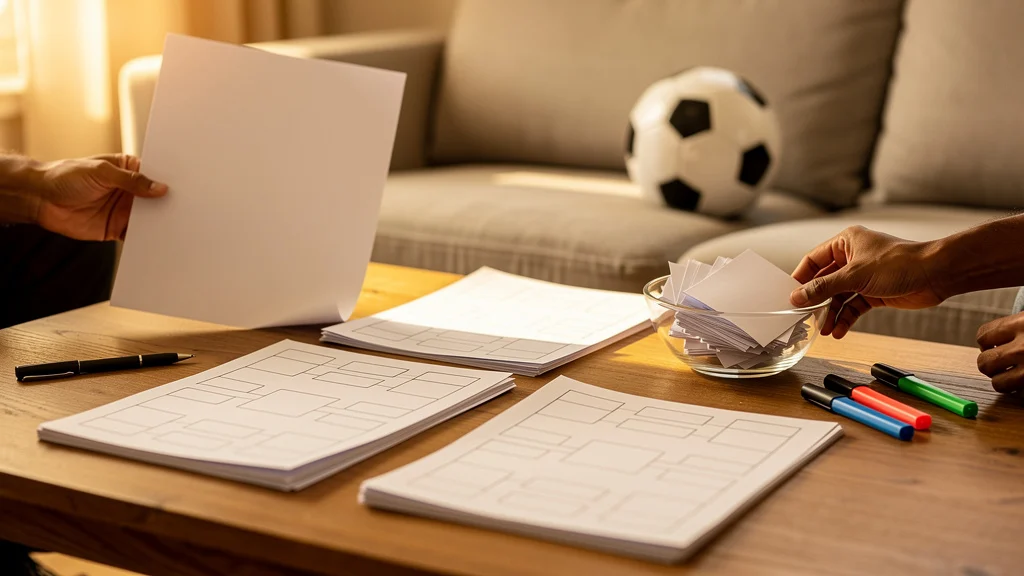
What Makes a Sweepstake Template Usable
Most free templates look fine on screen. Print them out and the problems start immediately.
The biggest culprit is font size. Designers often shrink team names to squeeze all 32 slots onto a single A4 sheet, which leaves you with text that's borderline unreadable once it's been photocopied in a staffroom or printed on a budget inkjet. A usable template sets a minimum of around 10pt for team names and at least 12pt for the drawn participant's name, because that name gets written by hand, in a rush, at a pub table. Each slot also needs a dedicated space for a cash amount, not just a tiny bracket or a line so short it'll fit four characters. When the pot grows through a sweepstake, people want to record what they've paid in. If the template doesn't accommodate that clearly, someone will scribble over the design and the whole thing looks a mess by the group stage.
Clear visual separation between teams matters too. A grid where every cell bleeds into the next makes it genuinely difficult to check who drew which country, especially across a crowded office. Bold borders, alternating shading, or generous row spacing all solve this. The format should also survive a black-and-white print run without losing any information, because colour printing is not a given for most people running a sweepstake at short notice.
Which Format Suits Your Group?
A printed sheet works well for most gatherings, and it is the format people default to for good reason. You hand it out, teams get drawn, everyone can see the full picture on one page, and there is nothing to log in to or download. For a group of ten to thirty people sitting in the same room, a printed draw is hard to beat.
Where it falls down is when your group is spread across different locations, or when you need to handle late entries and swaps without scribbling over the original. If the pot is cash rather than bragging rights, a physical record that everyone has signed off on also keeps things honest and avoids disputes later.
A shared spreadsheet suits a mixed group that is comfortable with a Google or Excel link. You can update it in real time, add a column for stake amounts, and share it with people who are not in the same office or pub. It does require someone to own the file and manage access, which is a small but real overhead if you are already organising everything else.
Online draw tools handle randomisation automatically, which removes any suspicion of a rigged result. They suit tech-confident groups and work particularly well when entries come in at different times. If you are weighing up which approach fits a bigger or more distributed group, the breakdown in our guide to running things efficiently online gives a useful frame of reference. For a casual sweep among friends, though, a printed sheet and a hat still do the job.
How to Run the Draw Fairly
The fold-and-pull method
The simplest method that nobody can argue with is the fold-and-pull. Write each team name on a separate slip of paper, fold them all the same way so no one can tell them apart, drop them into a hat or a mug, and have each participant pull one out blind. If someone cannot be there in person, nominate someone else to pull on their behalf and photograph or video the moment. That one step, capturing the draw on camera, removes almost every dispute before it starts. No one can claim the draw was rigged if the whole thing is on someone's phone.
Remote draws
If your group is spread across group chats and nobody is in the same room, a free online random number generator works just as well. Assign each team a number, share your screen or record it while the generator runs, and post the result in the chat immediately. Transparent, repeatable, and just as defensible as the hat method.
Late payers and drop-outs
Late payers and drop-outs need a clear rule before the draw happens, not after. The fairest approach is to hold any unpaid team in a separate pile and only add it to the draw once the money lands. If someone drops out after the draw, decide in advance whether their team goes back into a re-draw or is simply void. Both are reasonable. The one thing that causes genuine bad feeling is making that call on the spot, under pressure, once people already know which teams are involved. Set the rule early, write it on the sheet alongside your terms of participation, and there is nothing left to argue about.
Adapting the Layout for Different Group Sizes
The biggest practical difference between a small gathering and a large office sweep is how you handle the maths when participant numbers don't divide cleanly into the total teams on offer. A World Cup typically fields 32 nations, which splits perfectly across eight people with four teams each, or 16 people with two apiece. Once you move beyond those tidy numbers, things get untidy fast.
An office of 40 means some people draw fewer teams than others, and that imbalance needs to be agreed upfront rather than discovered on the day. The cleanest fix for larger groups is to add a small entry fee, then split the pot proportionally so anyone holding fewer teams gets a slight refund if their allocation is short. Write that rule on the sheet itself so there's no dispute later.
For smaller squads, splitting a single team between two people is rarely a good idea. You end up with half-prize arguments the moment that team reaches a semi-final, and no layout handles fractional ownership gracefully. Better to remove the weakest-ranked nations from the draw altogether and keep every participant on equal footing.
If you want a ready-made layout that already accounts for uneven group sizes, the guide to building practical web tools for small teams covers how flexible grid structures can help when you're designing printable documents from scratch.
Keeping It Legal and Low-Drama
Most office sweepstakes operate in a legal grey area that nobody thinks about until something goes wrong.
The good news is that a private sweepstake among friends, family or colleagues is perfectly fine under UK law, provided you follow a few straightforward conditions. The Gambling Commission's guidance on private arrangements is clear on this. No participant can make a profit from running the draw, the sweepstake must be confined to one location or a defined group of people who already know each other, and participation cannot be advertised to the general public. In practice, a shared WhatsApp group or a sheet pinned to the staffroom noticeboard is fine. A public Facebook post asking strangers to buy in is not. Keep the pot modest, make sure every penny collected goes into the prize fund, and you are well within the informal exemption.
The one rule that tends to cause friction at work is participation pressure. Nobody should feel obliged to hand over money to join in, and a free draw alongside the paid entries keeps everything relaxed. Print a spare copy, let people join for nothing if they prefer, and you remove the awkwardness entirely. It costs you one extra row on the sheet and saves the kind of HR conversation nobody wants to have on a tournament Friday.
Printing Tips So It Looks Good on the Wall
The difference between a sweepstake grid that gets ignored and one that becomes the centrepiece of the office is almost always print quality.
Before you hit print, check two things. Set the printer to its highest quality mode, usually labelled "Best" rather than "Normal" or "Draft", and make sure you are printing at 100% scale rather than letting the printer auto-shrink it to fit. That auto-shrink setting catches people out constantly. The names end up tiny, the grid lines merge, and nobody can read who has got Argentina from across the room. If you are using a standard home inkjet, choose plain paper over glossy for wall display as the ink dries faster and the sheet sits flat when pinned or taped up.
For any office with more than about fifteen people, print at A3. Four cramped A4 sheets taped together look makeshift, and the joins almost always cut through a team name or a column. A single A3 sheet looks deliberate. Most high-street print shops will run one off for under a pound, and the result holds its own next to any professionally made notice.
Laminating is worth the extra step if the sheet will stay up for the full tournament. A laminated print survives coffee splashes, re-pinning, and the occasional argument about who picked Brazil.