

Where You Rank, And What Happens Next.
Cleo can check your positions every day, every week, town by town, finds the searches worth going after, and turns the research into work you can approve.
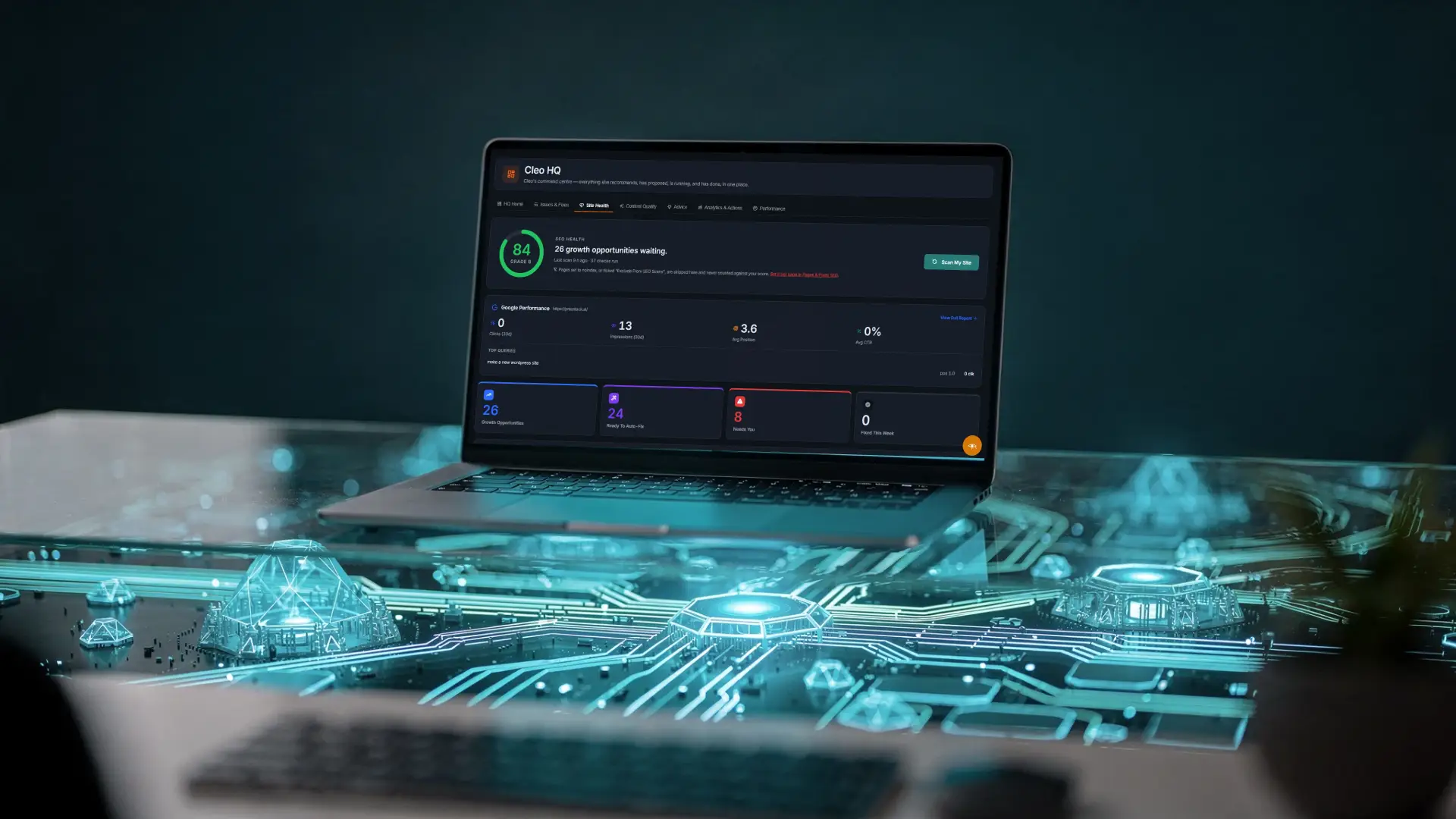
Your Whole Site Researched At Once.
Most reports tell you where you are and leave the work to you. Cleo combines your real Search Console data with related searches she finds, sorts every keyword by what the searcher wants, and shows you the gaps.
-
Site Wide Or One Phrase
Research across every page at once, or go deep on a single search before you build a page for it. Both start from your real Search Console data, so what you see reflects how people actually find your site.
-
What The Searcher Wants
Every keyword is sorted by intent, from its wording: Someone looking for information, a particular business, or something to buy. The right page for one looks nothing like the right page for another.
-
Searches You Missed
Cleo adds related searches your Search Console data doesn't show yet: Phrases real people use that your site hasn't been seen for. A few of them turn out to be easier wins than the ones you're already chasing.
-
Quick Wins, Sorted By Value
Searches where you sit fourth to fifteenth over the last 28 days, ordered by the extra clicks a move to the top would bring against how hard the move looks. You spend time on the moves that pay off most.
A Real Site, Checked By Cleo.
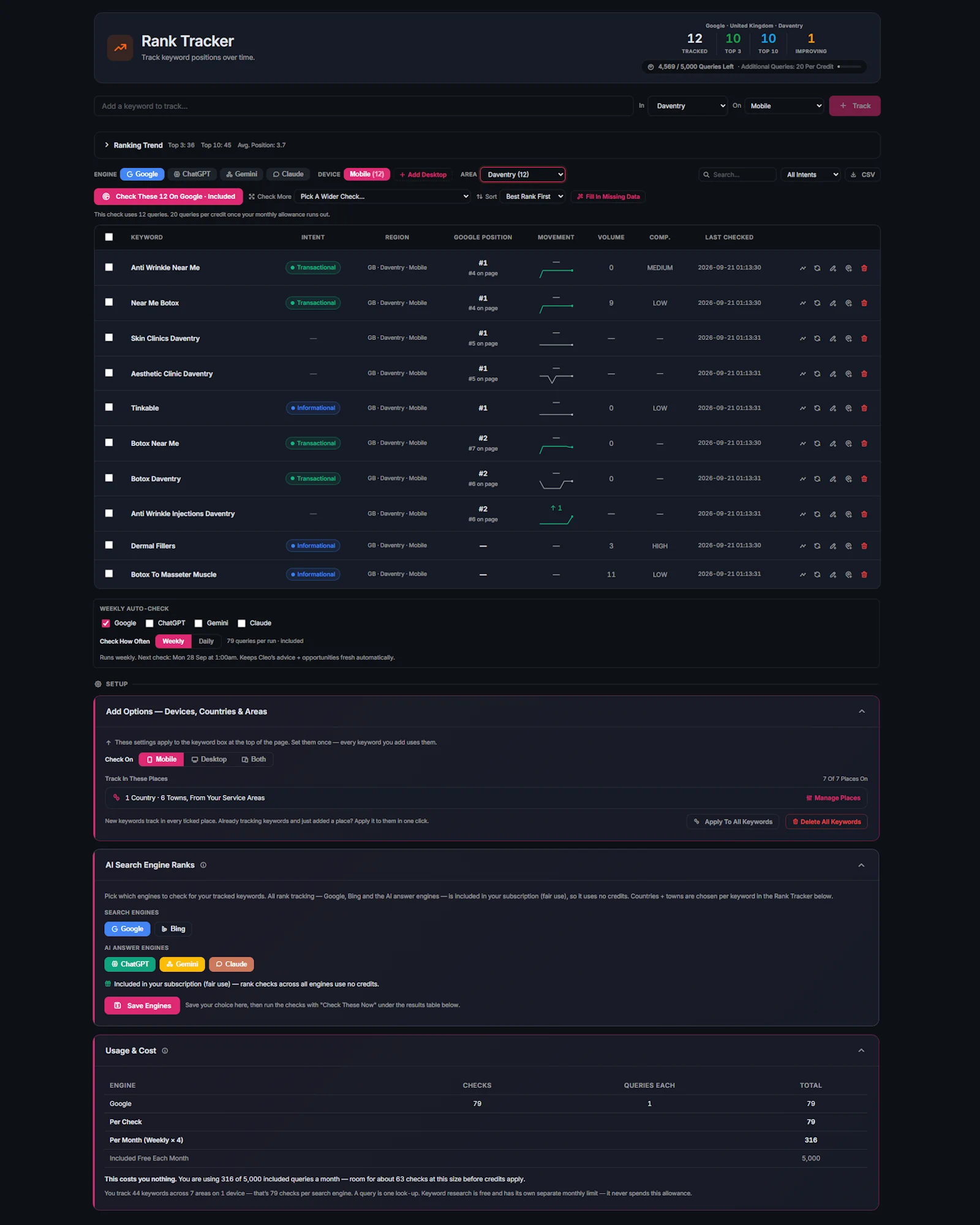
The Keyword
What you are tracking. Add keywords by hand, pull them from the research run, or use the manual research tool to go deeper on a single phrase.
Country And Town
Every keyword is checked in a country, and in the towns you choose from your service areas. An electrician in Manchester and an electrician in Edinburgh are different searches with different answers.
Search Engine Position
Your position in Google, and in Bing if you switch it on. It's the result of a real search, which is why nothing here is real-time. Weekly by default, or daily if you prefer.
AI Answer Results
ChatGPT, Claude and Gemini, when you switch them on. They don't return a list of links, so what's recorded is different: whether the answer mentions your business by name. AI answers are checked for the country, not town by town.
Ranking Change
Movement since the last check, per engine. A drop is the column that matters. It tells you something has changed for that keyword and gives you a place to start.
Last Checked
The date sits on every row so you always know how fresh the number is. Set checks to run weekly by default or daily if you need tighter visibility.
Coverage Options
Add towns, devices and engines to widen coverage, or narrow it to keep query use down. One Google or Bing check uses one query. One AI check uses twenty.
At A Glance
A summary row for every town you are tracking, so improving keywords and slipping ones are visible without opening each one individually.

Five Engines. One Connection.
The Issues Reports Miss.
Rank position is one signal. Cleo reads four others that explain why a position is what it is, and what to do about each one.
-
Content Gaps
Searches where your site already gets ten or more appearances but has no page built for them. Google is showing you for that search and you have nothing focused to show back.
-
Competing Pages
Two of your own pages chasing the same search and weakening both. Cleo names them, shows which one is stronger, and says whether to merge them or make them more distinct. Town pages are never merged.
-
Content Decay
Articles losing visitors are flagged while there is still something worth saving, so a refresh can recover what would otherwise need a rewrite.
-
Backlinks
How many links point at your site, how many sites they come from, and how strong your domain is, with broken backlinks picked out.
Everything In Core And Theme.
Every one of these is in Presstack Core and Presstack Theme, with no rankings add-ons. Writer & SEO keeps the Search Console findings (quick wins, page two, gaps, competing pages) but has no rank tracking, keyword research or backlinks. Research doesn't use credits, and rank checks come out of a monthly allowance.
| What It Does | Plain English |
|---|---|
| Watching | |
| Rank tracking | Your position for each keyword in Google, and in Bing, ChatGPT, Claude and Gemini if you switch them on. |
| Position drops | Notices when a page slips, and tells you which page and which search. |
| Dropping out of search | Notices when the number of pages Google is allowed to show falls. |
| Getting back in | Puts back pages that were switched off from search, with your approval. |
| Researching | |
| Keyword research | Across the whole site, combining your real Search Console data with related searches you have not covered. |
| One keyword in depth | Everything about a single phrase before you build a page for it. |
| Searches you hadn't thought of | Finds phrases related to what you already do. |
| What the searcher means | Works out from the wording whether a search wants a service page or an article. |
| Where they are | The same keyword tracked in as many towns as you need. |
| Finding the work worth doing | |
| Quick wins | Searches where you rank fourth to fifteenth, sorted by what improving them is worth. |
| Page two searches | Positions eleven to twenty, one step from being seen by many more people. |
| Reading Search Console and acting | Takes the findings and proposes the work, rather than showing you a chart. |
| Content gaps | Searches with real demand and no page built for them. |
| Articles losing visitors | Finds posts that used to get traffic but have slipped. |
| Competing pages | Two of your pages going after the same search, and whether to merge them. |
| Topic groups | Plans a main article and the supporting ones around it, linked together, to cover a subject properly. |
| Seen but not clicked | Pages that appear often but rarely get clicked, with new titles and descriptions to choose from. |
| Pages people leave straight away | Reads your Google Analytics and finds them. |
| Whether your link text varies | Every link saying the same thing is a problem, so she checks. |
| Backlinks | Your link totals, linking sites, domain strength and broken backlinks. |
| Quality scoring | |
| Experience, expertise and trust | Scores how much a page shows of each. |
| Google's "is this helpful" test | Scores your writing against it. |
| Google's own reviewer guidelines | The same idea, against the published guidelines. |
| How strongly you cover a subject | Scores a topic you choose across the whole site. |
| Keeping up | |
| Google updates | Watches Google's own announcements for changes to how it ranks things. |
| Search trends | What is rising in your country, from Google Trends. |
| Searches for your name | Whether people are looking for you specifically, and whether that is growing. |
| A daily snapshot | Your key figures saved every day, so you can compare later. |
It's Called Presstack Because It Replaces Your Stack.
The saving isn't only the subscriptions, though those add up. It's that the reporting and the SEO work stop being two separate jobs.
| Doing It Yourself | With Cleo | |
|---|---|---|
| Rank Tracking | A separate subscription, per site | Included on Core and Theme, Google and Bing |
| AI Visibility | Asking AI engines yourself and writing it down | ChatGPT, Claude and Gemini checked for you |
| Keyword Data | Another subscription, and an API key to keep alive | Comes through us. Nothing to connect |
| Finding Quick Wins | Exporting Search Console to a spreadsheet and sorting it | A ranked list, with the likely gain against each one |
| Spotting Competing Pages | Noticing it eventually | Found and paired up, with a recommendation |
| Deciding What To Do Next | You, on a Sunday | The findings arrive with the fix attached |
| Doing The Work | Also you | Approve each fix, or let her get on with the routine ones |
| Get Started |
Positions Are Only Half Of It.
Getting Found On Google
The titles, the descriptions, the links between your pages. The groundwork a ranking sits on.
Getting Found
Writing And Content
A page that ranks eleventh usually needs writing, not tweaking. This is who does the writing.
Writing

AI Search
The same questions, put to ChatGPT, Gemini and Claude, and whether you get named.
AI Search

Finding And Fixing Problems
A page that dropped might not have been outranked. It might just be broken.
Site HealthFrequently Asked Questions

-
It's your choice. The default is once a week.
That's deliberate rather than a limitation. Positions move day to day for reasons that have nothing to do with your site: someone else published, where the searcher was, which version of the results Google served. Checking daily gives you a jagged line and uses more of your allowance. Checking weekly gives you a trend.
The date of the last check is on every row, so you're never looking at a number without knowing how old it is.
-
No, and nothing honestly is.
Search results are checked weekly by default. Answers from the AI engines are kept for a week as well, because the same question gets broadly the same answer for everyone. Checking again inside that week is free and doesn't touch your allowance.
If a tool tells you your rankings update live, ask what it's actually measuring.
-
No, and that's one of the bigger savings.
Ranking and keyword data reaches you through us rather than through an account of your own. There's no second subscription, no API key to look after, and nothing to reconnect when a key expires.
The only thing you connect is your own Google Search Console and Analytics, once per site. Presstack only reads them; it never writes anything back.
-
Rank checks come out of a monthly allowance of 5,000 queries on Core and Theme.
One keyword in one place is one query, so 10 keywords in 10 towns is 100 queries to check them all once. An AI answer check is 20 queries, and AI answers are checked for the whole country rather than town by town. Past the allowance, every 20 queries use one credit.
Research doesn't use credits: keyword research, gaps, quick wins and competing pages are all free to look at. Credits are spent when she writes or rewrites something, and she tells you the cost before you confirm.
-
It's not a position in a list, because there isn't one.
When Cleo checks ChatGPT, Claude or Gemini, she puts your question to the engine and reads the answer. What is recorded is whether your business is mentioned, by name or by a link.
That's a different measurement from a Google position, and it's shown as one. There's more on the AI search page.
-
Yes, and for a local business it's the only way of tracking that means anything. Over 100,000 towns are available.
A national position for "physiotherapist" tells a clinic in Camden nothing. The same phrase checked in Richmond, Putney and Slough is three different answers, and the gaps between them are where your work lies.
Each extra town on a keyword is one more query per check, from the same monthly allowance.
-
They sound similar but they're opposites.
A quick win is a page you already have, ranking between fourth and fifteenth for a search people make. The page exists and it's close. It needs a refresh.
A gap is a search your site already gets seen for, but with no page built for it.
One improves what is there. The other creates what isn't. She keeps them in separate lists because the decision is different.
-
Your own Search Console data over the last 28 days.
She takes every search where you average between fourth and fifteenth, works out roughly what improving it would be worth in extra clicks, weighs that against how hard the move looks, and sorts by the result.
Top of the list isn't the highest search volume. It's likely gain against likely effort, which is the order you'd want to work in.
-
No. We can't promise rankings, visitors or sales. Nobody can.
What happens in search depends on your competitors, your industry and Google, and none of them take instructions from us. What Cleo does is the work that gets skipped: writing regularly, keeping the site sound, and telling Google clearly what the business does.
If a tool promises you positions, it's either guessing or lying.
-
No. Everything starts on Ask Me.
Two switches let her do the routine work by herself: Behind The Scenes Fixes and Search Listings. New articles are saved as drafts unless you choose to publish, and changes to what your pages say always ask first.
Anything that runs on its own has a monthly credit limit you set. Every change is dated, and changes to pages, posts, products and images can be undone for 30 days.
-
No. Everything on this page is in Core and in the Theme.
Presstack Core is a plugin. It goes on the site as it is and leaves your theme and page builder alone. Presstack Theme becomes the website, with its own design system and widgets. Writer & SEO, the smaller plugin, has the Search Console findings but not rank tracking or keyword research.
-
The history stays on your site, in your own WordPress database.
What pauses is the checking: rank tracking, keyword research and backlinks all need the subscription, because they are work she does rather than files you own. Your website keeps working.
-
Per site. Every site has its own subscription and its own allowance.
There's no shared pot to run dry, and nothing one client uses affects another. Each site reports on its own, so you stop logging into fifty trackers to find out most of them are fine. There's more on the agencies page.
-
Yes, once you switch it on.
Each Bing check is one query from the same allowance as Google. It's worth having: Bing is small next to Google, but it sits behind a good deal of what AI assistants show, so doing badly there is worth knowing about.
Stop Reading Reports. Start Clearing.
Put it on one site and see what she finds: positions town by town, the searches you're closest to winning, and the pages quietly competing with each other.