
Does ChatGPT, Claude, Or Gemini Mention Your Business?
Cleo puts the questions your customers ask to each AI engine separately, then tells you whether your business is named in the answer.

AI Answers Name Just A Few Websites. Yours Needs To Be One Of Them.
When someone asks ChatGPT which accountant to use, or which agency built the best e-commerce sites in their sector, they get an answer. Not ten blue links. An answer. That answer names a small number of businesses and stops. If your business is not named, you are not second on the list. You are absent entirely, and there is no page two to fall back on.
-
You Choose The Questions
The ones your customers actually ask, phrased the way they ask them. Broad one-word trade terms almost always bring up the biggest national names and very few others. That is normal rather than a fault, and it is why the questions you track matter more here than anywhere else.
-
Cleo Asks Each Engine Separately
She puts each question to ChatGPT, Gemini and Claude one at a time, and each one runs a real web search before it answers. Each engine answers differently, so each gets its own result.
-
Named Or Not, Recorded Against The Date
She records whether your business was named, against the date the check ran. That builds a history over time, so you watch a pattern develop across weeks rather than a snapshot of today.
-
The Page Itself
Cleo can also score a page on what AI tools and Google look for: Experience and trust, whether it passes Google's helpful content test, how it measures up to Google's reviewer guidelines, and whether the people writing are properly identified.
What Cleo Finds When She Asks The Engines.
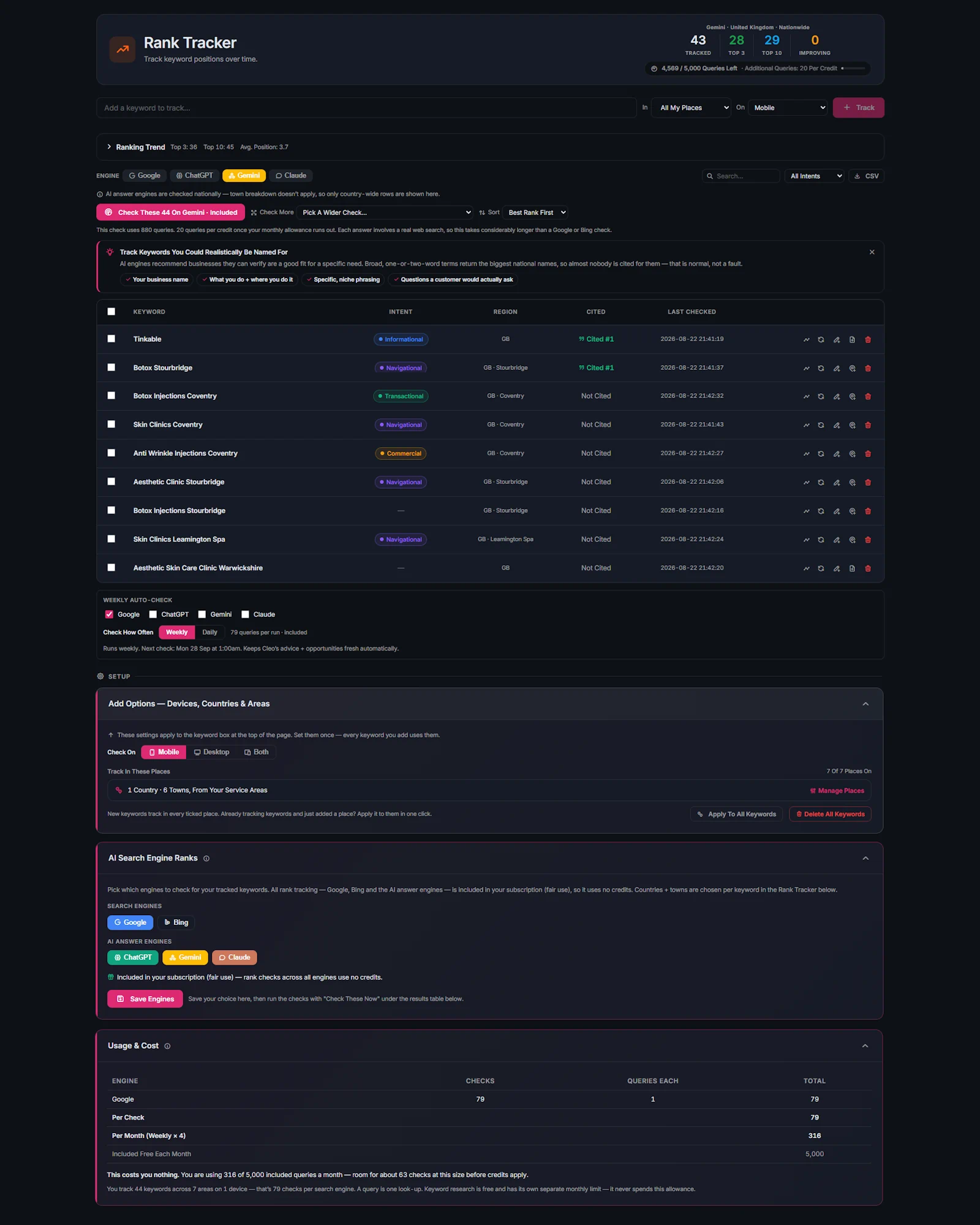
An AI check on a real website. Hover a marker to read what each part of the screen is telling you.
The Engine Tabs
ChatGPT, Gemini and Claude each appear on their own tab. They are asked the same questions separately, because they return different answers and cite different sources.
Named, Or Not
She looks for your business by name as well as by web address: your business name, your brand name, your site title and the name in your web address, with endings like Ltd dropped. An engine often names a business without linking to it, so she checks for all of them.
Country, Not Town
Checks run for a whole country. An engine asked about a specific town answers from what it knows nationally, so there is no town-by-town breakdown. You can check in more than one country.
Search Intent
Each question is marked with its search intent, worked out from the wording. Intent decides whether a dedicated page or an article is the right thing to have ranking for that question.
Last Checked
Every row shows the date the question was last put to the engines. Pull up the history for any question to see how citation and position have moved over time.
Act On A Gap From Here
Missing a town you should be named for? Start a page for it straight from the row.
Queries Remaining
Your running total of queries used this month, against the allowance included with Core and Theme. No credits are used inside it.
Engine Selection
Track one engine or all three. You choose which ones to include, so you can match the scope of tracking to your priorities.

Every Check Recorded. Every Pattern Visible.
A single check tells you where you stand today. The pattern across several weeks tells you something you can act on. Cleo stores every result against its date, so you can see whether your citations are growing, shrinking or staying flat, and tie that movement to the content changes you made.
-
The Check Itself
Your question goes to ChatGPT, Gemini and Claude separately, and each runs a live search. She looks for your business by name and by web address, because an engine may name you without linking to you. A check counts as twenty queries because a live AI search costs far more than a Google look-up.
-
A History, Not A Copy
What's stored is whether you were named, against the date. That's a history over time. It isn't a copy of what the engine said.
-
Country Wide
AI engines do not answer by town. A question about a specific town draws on what they know nationally, so checks run for the country, and you can add more than one.
-
Answers Kept For A Week
The same question gets broadly the same answer for everyone, so an engine's answer is kept for a week. Checking again inside that week doesn't use your allowance.
In Presstack Core And Presstack Theme.
There's no AI search add-on. AI checks are part of Core and Theme (Writer & SEO doesn't include them) and come out of the same monthly allowance of 5,000 queries, with no credits used inside it. An AI check counts as 20 queries; a Google or Bing check is one.
| What It Does | Plain English |
|---|---|
| Checking | |
| AI visibility checks | Puts your question to ChatGPT, Gemini and Claude and looks to see if you are named. |
| By name, not just by link | Tries your business name, site title and the name in your web address, because an answer names a business, not a URL. |
| Weekly, daily, or when you ask | Your choice, on a schedule, with no reminder needed. |
| More than one country | Ask in as many countries as you need. AI answers are country wide. |
| Export it | The whole table as a spreadsheet. |
| Keeping Up | |
| Google updates | Watches Google's own announcements for changes to how search works. |
| Searches for your name | Whether people are looking for you specifically, and whether that's growing. |
Say Goodbye To Asking By Hand.
You could ask AI yourself. But you wouldn't do it every week, on all your sites, and you wouldn't keep the results.
| Doing It Yourself | With Cleo | |
|---|---|---|
| Finding Out If AI Mentions You | Asking ChatGPT and writing the answer in a note | Three engines, on a schedule |
| Keeping A History | You won't | Every check kept, with the date |
| Knowing If It's Moving | No way to tell | A run of dates either side of the work you did |
| Knowing What To Change | Guesswork, or an article you read | Your pages scored and the gaps listed |
| Doing Something About It | Yet more research | Start the page from the row |
| Get Started |
What Actually Makes The Difference.
The Knowledgebase
Instead of writing from the web, which makes content about everyone but you, Cleo writes from your knowledgebase, so it is all about you.
Knowledgebase

Rankings And Research
Google and Bing, checked town by town and recorded, all inside WordPress.
Rankings

Writing And Content
Pages that answer real questions, which is what gets quoted in an AI model's answer.
Writing

Getting Found On Google
The groundwork done properly: clear titles and descriptions, schema that describes the business, and files that help AI tools read the site.
Getting FoundFrequently Asked Questions

-
No. Nobody can, and anybody who says otherwise is selling you something.
What gets named in an answer is the engine's decision, made from what exists to be read about your trade and your area. We can't instruct it, pay it, or influence it.
What Cleo does is find out where you stand, tell you what's missing from your site, and do the work that makes being named more likely - clear pages, stated facts, evidence behind claims, and your business properly described in a form machines can read. That's the honest version of this, and it's the only version there is.
We can't promise rankings, visitors or sales. Nobody can.
-
Probably not. Look at the keywords first.
These engines recommend businesses they can verify are a good fit for a specific need. Ask one for "dentist" and you'll get the biggest national names, because that's the only sensible answer to a question that broad. Almost no small business is cited for a one word trade term, and that isn't a fault in your site or in the checking.
Track things you could realistically be named for instead. Four that work:
- Your business name
- What you do and where you do it
- Specific, niche phrasing rather than the broad category
- The question a customer would actually ask out loud
Get those right and the engines may start naming you.
-
No, and it's worth being clear about that.
She asks the question, looks for your business in the reply, and records whether you were named, against the date. What she keeps is the result and its history, not the engine's answer itself.
You could ask yourself to get the full answer. What you can't do by hand is ask fifty questions for fifty websites across three engines every week for a year and keep the record. That's the part Cleo does.
-
Yes. Each engine runs a real web search before it answers.
That is why an AI check takes longer than a Google or Bing check, and why it counts as twenty queries rather than one. What the engine does with that search is its own business and can differ from one question to the next. So the honest description is: she asks the question a customer would ask, and records whether you were named in what came back.
-
It means your business was named in the answer.
That's not a Google position, and the screen doesn't dress it up as one. When the engine lists its sources, the position is where your site sits in that list. When you're named in the text without a link, it's recorded as named.
-
For Google and Bing, yes - that's the point of them, and the towns come from the service areas you put in your knowledgebase.
For AI answers, no. AI engines work differently. Think of a town name as a keyword that forms part of the question, rather than as an area.
AI answers are generally grouped per country, but you can check more than one country. For a business working across borders that's a real difference.
-
Weekly by default, on a set day and time. You can set it to daily, or check whenever you like.
AI answers move slowly, so weekly is usually best, and an answer is kept for a week anyway. Every row carries the date it was last asked.
-
Because they are the three biggest mainstream AI assistants in use today.
We did add others, such as Perplexity, but the cost per check was too high for how rarely they are used. There is no point paying over the odds to add an engine few of your customers use.
-
Nothing in credits, inside the monthly allowance of 5,000 queries on Core and Theme.
An AI check counts as 20 queries, because each one runs a real search. A Google or Bing check is one. So one question checked weekly on all three AI engines plus Google and Bing is 62 queries a week, around 270 a month. That allowance covers roughly eighteen questions watched everywhere, every week. Watching Google and Bing only, it covers well over five hundred.
Past the allowance, every 20 queries use one credit. The screen shows what a check will use before you run it. Checking your pages, scoring your writing and seeing what is missing cost nothing at all.
-
No, and be careful with anyone who frames it that way.
Most of what makes a business appear in an AI answer is ordinary work done properly: Pages that say plainly what you do and where, a clear description of the business, real evidence behind claims, and somebody's name on the writing. The same things that have always mattered.
There are a few genuinely specific bits, which is why this section exists - spoken questions, being the answer rather than the link, and checking whether you appear at all. But if a site is a mess for ordinary search, it will be a mess for AI too. Start on normal search SEO first.
-
No. Everything on this page is in Core and in the Theme.
Presstack Core is a plugin. It goes on the site as it is and leaves your theme and page builder alone. Presstack Theme becomes the website, with its own design system and widgets. Writer & SEO, the smaller plugin, does not include AI checks.
-
The checks stop. The record stays.
Every result she has collected is in your own WordPress database and stays there, and you can export it. What pauses is the asking. Your website keeps working.
-
It's the easiest thing on this list to start a conversation about, because the client already knows AI answers exist and nobody has told them where they stand in one.
Two cautions, so the conversation goes well. Pick the keywords properly. A client who sees "not cited" against fifteen broad terms will think the tool is broken rather than that the terms were wrong. And don't promise to fix it, because nobody can promise that. Show them where they stand, show them how their pages score, and sell the work rather than the outcome.
There's more on that on the agencies page.
Find Out If You Are Named.
Put your site in and Cleo asks the engines your chosen questions. You will know whether your business appears in AI answers or not.