
Images Are The SEO Work That Never Gets Done.
A media library that writes its own descriptions, finds the files slowing your site down, and searches your own library before making anything new.

Four Thousand Images. Nobody Has Ever Described Them.
Every site that has been running for more than a year has the same problem. Hundreds of images uploaded in a hurry, file names left as they came off the camera, and description fields left blank.
-
The Library Itself
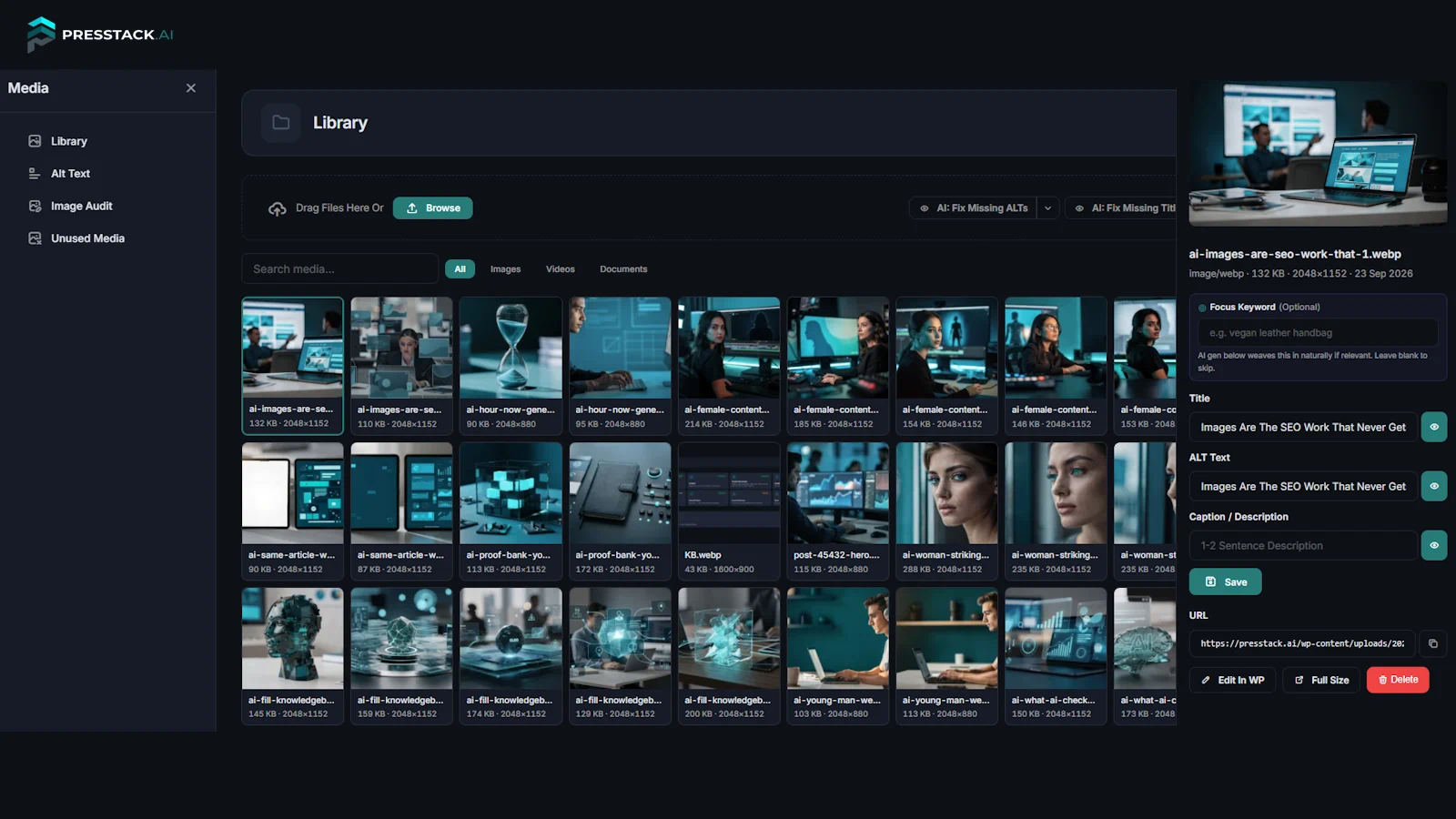
A media screen that shows file size and pixel dimensions on every tile. Drag files in or browse your folders, search by name, and filter to images, video or documents. Each file has a panel with its title, alt text, caption and address, and a link to edit it in WordPress. Everything is saved in the standard WordPress fields, so if you remove the plugin, nothing is lost.
-
Descriptions And Titles Across The Library
Cleo writes alt text for every image that has none, and titles for images whose title is empty or still the file name. Existing descriptions are left alone. Add an optional focus keyword and she works it in where it fits what's in the picture. Describing images costs no credits.
-
Heavy Images Found And Shrunk
The daily check flags images over 500 KB, with their size and dimensions. Shrinking brings anything over 2560 pixels down to that size and re-encodes it. The original is kept first, so Cleo can put it back exactly as it was.
-
Unused Files Found And Put Somewhere Safe
Cleo checks featured images, page content, Elementor and other page builder layouts, and shop galleries to find files that nothing uses. A photo used only inside an Elementor section is not reported as unused. Deleted files go to a bin you can restore from.
Upload, Search, Describe, Audit. All In One Place.
Presstacxk media library on a real site, with one image selected. Hover a marker to see what each part does.
Fill Every Missing Description
One button works through the whole library, a batch at a time. Cleo writes alt text for every image without one, and does the same for missing titles. Or handle a single image from its own panel.
Four Different Areas
Library, descriptions, the oversized image audit, and unused files. All four sit in the left navigation, so you go straight to the one you need. Your full image stack is here, not buried in a settings page.
Upload and Search
Drag files in or browse your folders. Search by name. Filter to images, videos or documents. It is a working library built into WordPress, not a report about one.
What Cleo Wrote
A description of what's in the picture, not a restatement of the file name. It sits alongside the title and caption, and you can edit any of them before saving.
A Focus Keyword
Optional. Give Cleo a phrase and she works it in where it fits the image naturally. Leave it blank and she describes what she sees, which is usually the right call.
Size and Dimensions
File size and pixel dimensions appear on every tile. You can see which files are heavy at a glance, without opening anything.
WordPress Native
Edit in WordPress, open the full size file, or copy the address. Everything is saved in the standard WordPress attachment fields. Nothing is locked in, and nothing breaks if you remove the plugin.
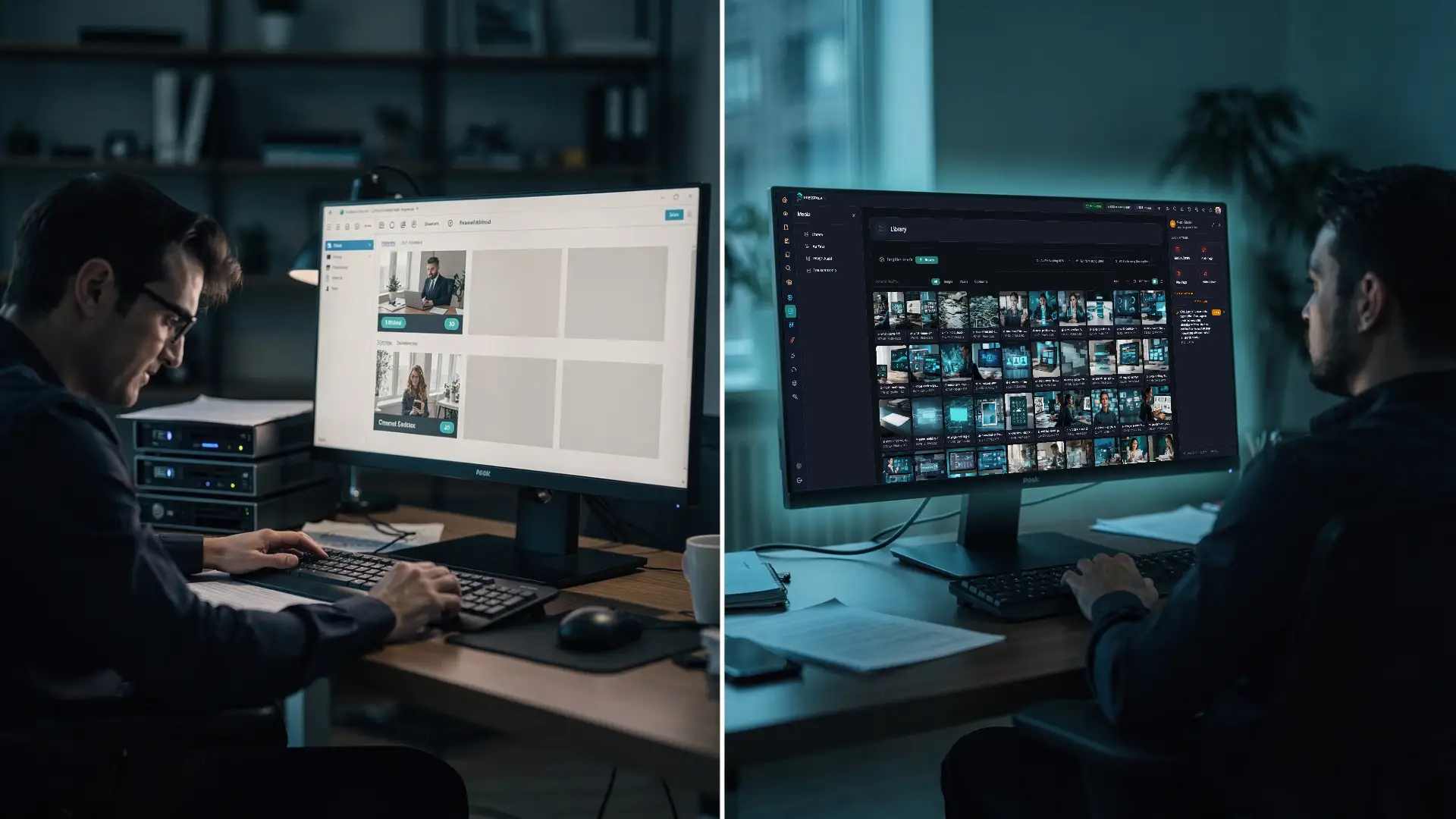
What Image SEO Looks Like Without Cleo
Every item in this list is work that gets skipped, not because site owners do not care, but because there is no tool that handles all of it in one place. Presstack changes that.
-
The Library Screen
The WordPress media screen shows files in a grid with no size or dimensions. You open each file to check its weight. With Presstack, size and dimensions sit on every tile, and one click filters to images, video or documents.
-
Writing Descriptions
Describing images means opening each one, typing into the alt text field and saving it. On four hundred files that is hours of repetitive work that never gets done. With Presstack, Cleo fills every blank in the library, at no cost in credits, and leaves existing descriptions alone.
-
Finding Heavy Files
Finding heavy images usually means running a speed tool, working out which files are the problem, resizing them in an image editor and uploading them again. With Presstack, the daily check lists every image over 500 KB, and Cleo shrinks the ones you choose, keeping the originals.
-
Clearing Unused Media
Done by hand, finding unused files is genuinely hard. A file might be used inside a page-builder layout rather than the page content, and deleting it breaks a live page. Cleo reads featured images, page content and page-builder layouts before calling anything unused.
The Full Picture, Before You Decide.
All of it is in Presstack Core and Presstack Theme.
| What It Does | Plain English | Costs |
|---|---|---|
| The Library | ||
| A library of its own | Upload, search, filter to images, videos or documents, with file size and pixel dimensions on every tile | Free |
| Native WordPress | Everything saved in the standard WordPress fields. Edit in WordPress any time. Nothing locks you in | Free |
| Describe the whole library | Writes alt text for every image without it, a batch at a time. Existing descriptions are left alone | Free |
| Write the missing titles | The same pass for titles that are empty or still the file name | Free |
| Describe one image | For when you want to redo a specific file rather than the whole library | Free |
| An optional focus keyword | Worked in where it genuinely fits what's in the picture. Leave it blank and she describes what she sees | Free |
| Find the ones with no description | Shows exactly how many images have no alt text | Free |
| Finding And Making | ||
| Find an image you already own | Searches your library first, so an existing picture gets used instead of a new one being made | Free |
| Set it as the featured image | Uses an image already in your library as a featured image | Free |
| Generate a new image | When nothing suitable exists in your library. Saved to your media library as a lightweight WebP file | 2 credits (3 premium) |
| Weight | ||
| Find heavy images | The daily check flags any image over 500 KB, with its size and dimensions | Free |
| Shrink one | Brings anything over 2560 pixels down to that size and re-encodes it | Free |
| Restore the original | The copy saved before shrinking is kept. Ask Cleo and she puts it back exactly as it was | Free |
| Unused Files | ||
| Find files nothing uses | Checks featured images, page content, page-builder layouts and shop galleries, so a photo inside an Elementor section is not reported as unused | Free |
| Delete to a bin | Reversible. Restore any file if it turns out something still needed it | Free |
| Related, From Elsewhere | ||
| Find pages whose featured image has gone | The file was deleted, or never set, but the page still needs one | Free |
| Check image search readiness | An audit of how your images are set up for image search: file names, alt text, captions, format and size | Free |
Do You Know Anyone Who Actually Does This Properly?
You could do this yourself, and you haven't. Nor has anybody else. Describing images is the most commonly skipped job on the internet, which is precisely why it's worth handing over.
| Doing It Yourself | With Cleo | |
|---|---|---|
| Describing Them | Open each image, look at it, type a sentence | Press one button, or let her do it on Automatic |
| Titles | Nobody does this | The same button again |
| Doing It Consistently | The first fifty are good, the last fifty say "photo" | The two hundredth is like the first |
| New Images You Upload | You'll probably forget | Given alt text straight away, then described properly in the next pass |
| Needing A Picture For An Article | Search the library, give up, use a stock site | Your own library searched first, then a new image if you want one |
| Making One | A stock subscription, or a separate tool | Made for the page and saved to your library |
| Heavy Images | A compression plugin taking over everything | Found individually, with their size |
| Regretting A Shrink | Re-upload from wherever the original is | Ask Cleo to put it back. The original was kept |
| Finding Unused Files | Not practically possible by hand | Listed, including ones inside your page builder |
| Deleting Them | Permanent, and you'd better be right | A bin. Bring it back if you were wrong |
| Get Started |
How Presstack Handles Your Images, From First Upload To Final Audit.

Finding And Fixing Problems
Oversized pictures are one of the checks the site audit runs. See what else it covers.
Site Health

Writing And Content
Articles need pictures. She searches your library before offering to generate anything new.
Writing

Getting Found On Google
Image search is its own search channel. A described picture is how you appear in it.
Getting Found

Online Shops
A product with no picture barely sells. She flags which of yours are missing one.
ShopsFrequently Asked Questions

-
It replaces the screen, not the files.
You get a proper library, upload, search, filter to images, videos or documents, with file size and dimensions on every tile. One panel per image holds the title, description, caption and address, plus an edit-in-WordPress button.
Underneath, everything remains ordinary WordPress attachments in your ordinary uploads folder. Every title and description Cleo writes is saved where WordPress expects to find it. Remove the plugin tomorrow and all of it stays put.
A media library you can't leave isn't a feature. This one you can walk away from.
-
Better than the alternative on every site we've looked at, because the alternative is nothing at all.
She looks at the picture and describes what's in it. "A dentist showing a patient an X-ray on a wall-mounted screen" rather than "dental image" or a raw file name. That sentence is useful to a blind visitor and a clear signal to Google.
What she can't know is context she was never given. She can see a man in a van outside a house. She can't know it's your van, or that the house is a job you completed in Edinburgh. If that context matters for a particular image, edit that one yourself.
-
It's optional, and it's honest about being optional.
Give her a phrase and she'll work it into the description where it fits what's actually in the picture. Leave it blank and she describes what she sees, which is the right call most of the time.
It exists for the case where an image sits at the centre of a page about something specific and you want the two to correspond. It isn't a tool for stuffing a phrase into two hundred descriptions, and it won't do that if you try. What's in the picture is what gets described.
-
Only generating a new image. Everything else on this page is included in the subscription.
Describing, titling, searching, shrinking, restoring, finding unused files and recovering deleted ones cost nothing. Generating a new image, when nothing suitable is in your library, costs 2 credits, or 3 for a premium image.
-
No. She fills blanks.
Any image that already carries a description is left exactly as you wrote it. If you want a specific one rewritten you can request that image on its own, but a bulk run will not overwrite existing text.
-
She reads the page builder layout as well as the post content, which is where most tools stop.
An image placed inside an Elementor or Divi section lives in the layout data, not in the post content field. A check that reads only the content field would decide nothing references it and report it as unused. You'd delete a picture sitting on a live page.
She reads the layout data too. So "nothing uses this" means nothing uses it. There's still a bin, because being careful twice costs nothing.
-
Ask Cleo and she puts it back.
Before she changes any image she saves a copy of the original alongside it. Restoring is exact: you get the file you uploaded, not a re-expanded version of a compressed one. That matters because shrinking is a judgement call. What looks fine on a blog photograph might not on a product shot where the detail is the thing you're selling.
-
It overlaps, and it works differently.
A compression plugin typically processes everything on upload, to a setting you chose once. The audit goes the other way. She finds the images that are slowing pages down, lists them with the page they appear on, and you decide what to do about each one.
If you already run a compression plugin you're happy with, keep it running.
-
They're yours, and they sit in your library like anything else you've uploaded.
Two practical cautions, not legal advice. Don't use a generated picture to show a product you actually sell: it would be a picture of something that doesn't exist. And in regulated trades, check the rules before using illustrated images of treatments or results.
If you have photographs of real work, use those.
-
No. Everything on this page works in Core and in the Theme.
Presstack Core is a plugin. It installs on the site as it stands and leaves your theme and page builder alone. Presstack Theme becomes the website, with its own design system and widgets. Both include all of the image features described here.
-
Only if you have told her to.
New uploads get alt text from their file name straight away. Proper descriptions come from the bulk button, or automatically if you switch Behind The Scenes Fixes to Automatic. Most people run the first pass themselves to check the quality, then switch it on so new images are handled without another thought.
-
It's one of the easier wins to show a client, because the before-and-after is countable.
"Your site had four hundred images and three descriptions. It now has four hundred descriptions." That's a sentence a client understands without explanation. It's an accessibility improvement as well as a search one,.
There's more on running this across multiple client sites on the agencies page.
-
Every description and title she's written stays written. It's in your own library, in ordinary WordPress fields. Every image she shrunk stays shrunk, and every original is still saved alongside it.
What stops is her doing new ones. Your website keeps working.
Find Out How Many Of Your Images Are Missing Their Description.
Install Presstack on one site and open the library. The number of images with nothing written against them is almost always higher than you'd expect.