
Over 30 Checks, Every Day, Whilst You're Not Looking.
Websites break without announcement. A link dies, an image vanishes, a page gets switched off from Google. Nobody tells you until a customer does.

Google Asks Just Four Questions.
Strip away the technical language and Google wants to know four things: Can it find the page, does it understand what you do and where, will people click it, and does it all stay consistent. Cleo, the AI built into Presstack, keeps all four in good order as the site grows and changes.
-
Can Google Find Every Page?
Cleo finds pages nothing links to, pages buried too deep in the site, and pages switched off from search by accident, and brings each one back into reach.
-
Does Google Know What You Do And Where?
Your services, opening hours and the towns you cover are written into the schema Google reads, straight from your business details. No code to write.
-
Will Anyone Click Your Result?
Ranking without being clicked is a slow loss. Cleo rewrites weak titles and descriptions, with three options to choose from, to earn more clicks on positions you already hold.
-
Does It All Stay Intact?
A single plugin update can undo months of work. The daily check looks at titles, descriptions, schema, links and redirects, and anything that breaks comes back to you with the fix worked out.
A Real Site, Checked By Cleo.
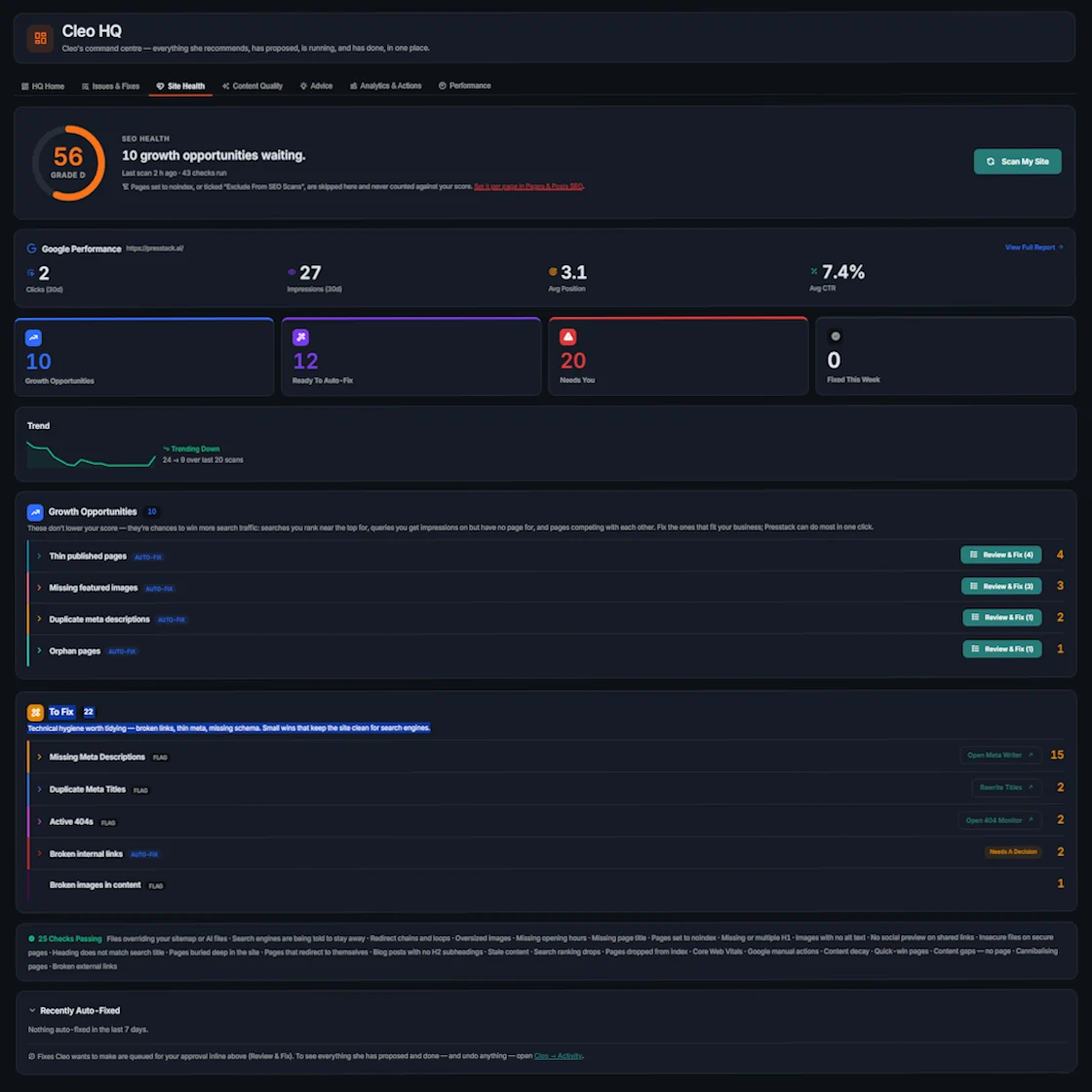
The Score
One number showing how the site is performing technically, and whether that number is moving up or down.
Growth Opportunities
Not faults. Gaps the site could close, things like missing content, underused pages, or areas where a new post would do real work.
Ready To Auto Fix
Faults Cleo can clear in one click. Switch that area to Automatic and she clears them without asking.
Needs You
Changes that affect what the page says. Cleo drafts the fix and asks before applying it.
Fixed This Week
Everything cleared since your last visit, with your approval or automatically, each with the date.
Checks Passing
Every check she ran and found nothing wrong with. On a well-maintained site, most of the list sits here most weeks.
Trend
A spark graph showing whether site health has improved or declined over the past several weeks.

How Cleo Keeps Your Site Healthy
Cleo Notices. She Fixes. Then Keeps Watching.
It's the checking nobody gets round to. Cleo doesn't produce a report and leave the work to you. She works out the fix, makes it once you've said yes (or straight away, for the areas you've set to automatic), and the next day's check confirms it held.
Schema, titles, internal links, redirects and indexing settings, all checked every day inside WordPress, with no monthly retainer and no spreadsheet.
-
Schema Google Can Read
Your business, its services and the places you work, described in the format Google reads. Built from your business details, kept current as they change, and flagged when it goes missing from a page.
-
Titles And Descriptions That Earn Clicks
Cleo reads your Search Console data every day. When a page is seen often but rarely clicked, she offers three rewrites to choose from, and Search Console fixes are measured again at four and eight weeks.
-
Internal Links And Redirects
Orphan pages, the ones nothing links to, are found and connected with your approval. Broken links are redirected, and redirect chains are pointed straight at the final page.
-
Indexing Watched Every Day
When a page gets switched off from search, the daily check catches it with a clear next step, not at your next audit. You can also ask Cleo to look at any page again whenever you like.
What Cleo Checks For.
These are the checks Presstack runs on every site, every day. Finding problems is free. Credits only apply where a fix writes content or generates an image.
| The Check | What It Means |
|---|---|
| Broken internal links | A link on your site pointing at one of your own pages that no longer exists |
| Broken external links | A link to another site that has died since you added it |
| Broken images in content | Images inside a page that no longer load |
| Missing featured images | An article whose main image no longer loads |
| Redirect chains and loops | A redirect that points to another redirect, or back round in a circle |
| Pages that redirect to themselves | A loop that stops the page loading at all |
| Orphan pages | A live page that nothing on the site links to |
| Pages buried deep in the site | A page that takes too many clicks to reach from the front page |
| Thin published pages | A live page with too little content to be useful to a visitor or Google |
| Stale content | An article that hasn't been updated in six months or more |
| Content decay | A page that used to bring in visitors and no longer does |
| Pages competing with each other | Two of your pages chasing the same search |
| Oversized images | Images over 500 KB, large enough to slow the page down |
| Missing image descriptions | Images with no alt text, unreadable to Google and screen readers |
| Missing page titles | Pages with no title for Google to show in search results |
| Missing or duplicate descriptions | The grey text under the blue link, absent or copied across several pages |
| Missing or multiple H1 | A page with no main heading, or several competing ones |
| Heading does not match the search title | The page says one thing and its Google listing says another |
| Blog posts with no subheadings | Long articles with no H2s to break them up |
| No social preview | Links shared on social media show no picture or summary |
| Insecure files on secure pages | Something loading over http that loses the padlock for visitors |
| Pages set to noindex | Pages hidden from Google, possibly by accident |
| Search engines told to stay away | The site-wide setting that hides everything from search |
| Files overriding your sitemap | A stray file blocking the sitemap or AI files Presstack provides |
| Pages dropping out of search | A fall in the number of pages that Google is allowed to show |
| Search ranking drops | A page that has slipped in position since the previous check |
| Near misses | Searches where you sit just off the first page |
| Missing opening hours | Not filled in, leaving what Google is told incomplete |
| Business details going stale | Your business details not reviewed for a while, so they may have drifted out of date |
| Database bloat | Junk building up in the database and slowing the site behind the scenes |
| Low credit balance | A warning before you run out, so nothing is blocked without notice |
Good Intentions Do Not Fix Broken Links.
| By Hand | With Cleo | |
|---|---|---|
| How often the site is checked | When something goes wrong | Every day |
| How broken links are found | A crawler, if you've set one up | The daily check, within a day of breaking |
| Who fixes them | You, when there's time | Cleo, with one click from you or automatically |
| Images with no description | Two hundred of them, forever | Written across the whole library |
| Duplicate titles | Nobody's ever looked | Rewritten, with options to choose from |
| Pages nothing links to | Invisible unless you go looking | Found and connected |
| Whether the fix held | Assumed | Confirmed by the next day's check |
| What it costs to look | An afternoon | Nothing |
| Get Started |
Once The Faults Are Cleared.
Getting Found On Google
With the breakages and blockages out of the way, this is the process that moves the needle on visibility.
Getting Found

Images
The job nobody finishes. Two hundred images with no alt text or captions, sorted without a manual edit.
Images

Writing And Content
Thin pages sometimes need writing from scratch rather than a light edit. Cleo does that too.
Writing

The Knowledgebase
One place for every fact about your site. Keep it current and Cleo draws from it every time she writes or checks.
KnowledgebaseFrequently Asked Questions

-
No. The checks run in the background, not when a visitor loads a page, so there is no effect on load time.
If you want to know how fast a page is, you can run a speed check on it whenever you like.
-
Site health covers things that are broken. Getting found covers things that could work harder.
A redirect loop is a fault and belongs here. A page title that's weaker than a competitor's isn't broken, it just has room to improve, and that sits in the other section. Your dashboard separates them the same way, because they call for different things from you.
-
Only until you decide otherwise. Everything starts on Ask Me.
Two switches let Cleo get on with the routine work by herself: Behind The Scenes Fixes (image descriptions, schema, broken-link redirects, pages switched off from search) and Search Listings (titles and descriptions). Changes to what your pages and products say always ask first, and you can approve items one at a time or all together.
-
Dismiss it and she stops raising it.
Not every flagged issue is a real problem on every site. Some are deliberate choices, and Cleo can't tell the difference until you tell her. Every change is listed with the date, and changes to pages, posts, products and images can be undone in one click for 30 days.
-
Often, yes.
She runs inside WordPress rather than as an outside tool knocking on the door, so she can see the site's own settings, its redirects and its business details as well as its pages. That's how she catches things like a stray noindex, a sitemap overridden by a leftover file, or business details that no longer match, and why she can fix the source of a problem rather than just report the symptom.
Point It At Your Worst Site.
The one you know needs attention. Run every check and get a full list of what needs fixing before you spend anything.