AI Search Rank Tracking Across ChatGPT Gemini and Claude
A client site sitting at position four on Google felt solid until we looked at what Gemini was actually saying about their services. It cited two competitors by name and skipped the client entirely. The Google ranking had not changed. The business was still losing ground. That gap, between where you appear in a traditional search result and whether an AI engine mentions you at all, is what AI search rank tracking is designed to close.

Google Position Is Only Half the Picture
When a growing share of searches end with an AI-generated answer rather than a list of blue links, your position in that list is only part of what determines whether a potential customer ever hears your name. Position four still matters. But it no longer tells you what it once did.
ChatGPT, Gemini and Claude do not return ranked results. They synthesise an answer and either name you or they do not. There is no position five in a Gemini response. You are cited, misrepresented, or absent, and those are meaningfully different outcomes, none of which appear on a traditional rank report.
The practical consequence is that two businesses can share the same Google ranking in the same sector and have completely different AI visibility. One gets cited regularly. The other never appears. Conventional reporting will not tell you which one you are.
What Cleo Tracks Across the Three AI Engines
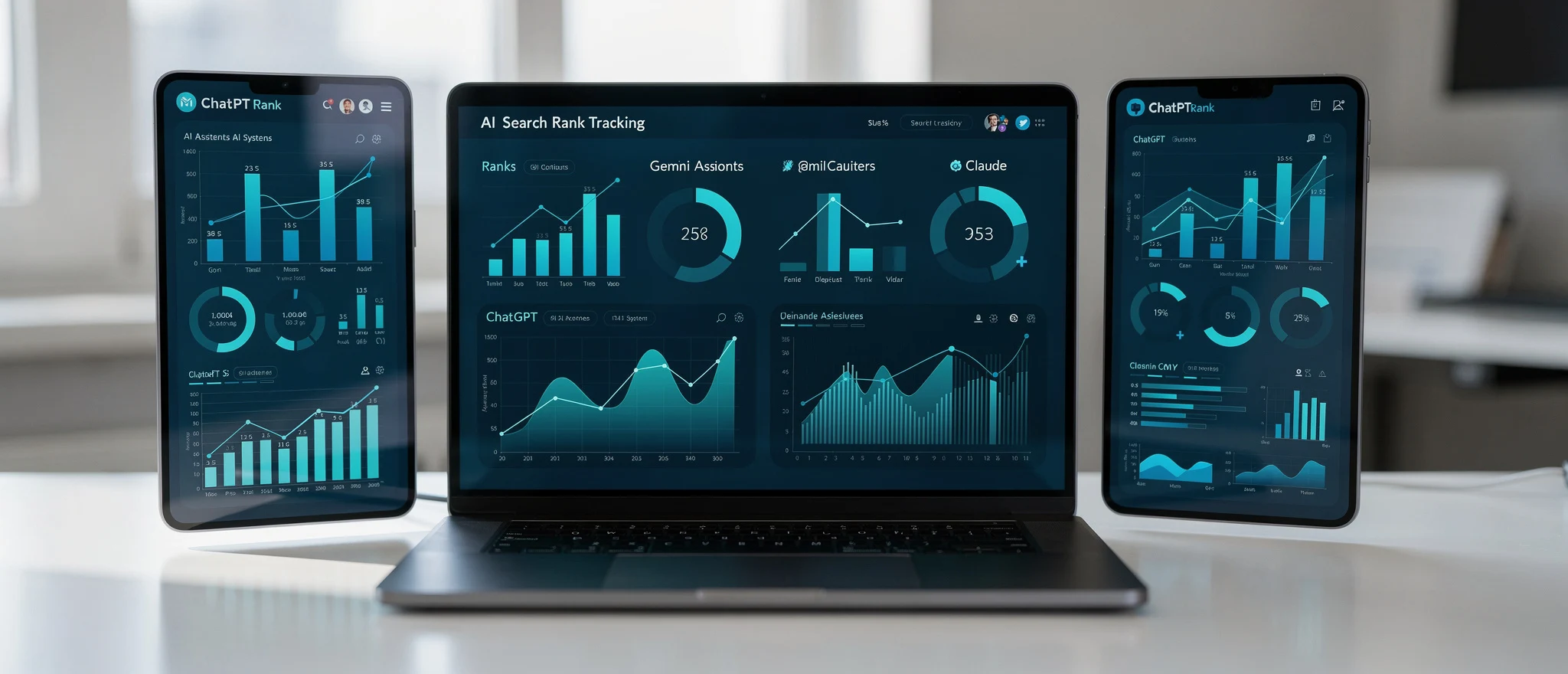
Presstack queries ChatGPT, Gemini and Claude directly, using the questions a real customer would ask about your type of business. The queries are drawn from your Knowledgebase, so they reflect your actual services, locations and specialisms rather than generic industry terms.
For each engine, Cleo logs whether the business was mentioned, whether it was cited accurately, and whether a competitor appeared in its place. A mention where the engine gets your service description wrong counts differently to a clean, accurate citation. Both matter, but they call for different fixes. All of this runs on a separate query allowance of 5,000 checks a month and does not touch your content credits, so the rank tracking metrics you see in your dashboard, across Google, Bing, and the three AI engines, are not eating into the budget you have set aside for articles and images.
Reading the Numbers Without Overreacting
Single data points versus patterns
A single absence in one engine on one day is noise. AI responses vary by phrasing, by time of day, and by what the engine has recently indexed or weighted, so one miss tells you almost nothing on its own.
What matters is the pattern over several weeks. Consistent citation in Claude but persistent absence in Gemini points to something structural, usually a gap in how the site describes the business in terms Gemini's training favours. A business that appears confidently in all three engines has generally done the work of making its services and location unambiguous across every public surface.
When misrepresentation is the real problem
Misrepresentation needs attention faster than absence does. If Gemini is describing your business correctly but attributing the wrong location, or naming a service you stopped offering two years ago, that is an active problem. A potential customer reading that answer gets wrong information and will act on it. That is a harder thing to recover from than simply not being mentioned.
How the Knowledgebase Shapes What AI Engines Say About You
AI engines learn from what is publicly available about a business. The more clearly and consistently a site describes what the business does, where it operates and who it serves, the more accurately those engines reproduce it in their answers. Vague or inconsistent copy tends to produce vague or inconsistent citations.
The Knowledgebase inside Presstack is where that description lives. Every article Cleo writes draws from it, which means the site's published content consistently reflects accurate, up-to-date information about the business rather than drifting into generic territory. This connects directly to how blogging frequency shapes authority in AI search, because repeated, accurate coverage of your core topics is what gives the engines enough signal to cite you with confidence.
When the tracking data shows an engine under-citing or misrepresenting the business, Cleo flags the specific gap. The fix is usually a Knowledgebase entry that makes the ambiguous point unambiguous, followed by articles that reinforce it.
A Metric That Changes How You Report to Clients
If you are running SEO for clients, the AI engine mention rate is the number that changes the conversation.
A client at position five on Google who never appears in a ChatGPT or Gemini answer is losing enquiries the rank report never accounts for. Showing them both numbers, traditional position alongside AI citation rate per engine, tells a more complete story and gives you a second lever to pull. Even if Google positions move slowly, improving AI visibility can show measurable progress within a single reporting cycle.
The agencies making the strongest case for their work right now are the ones who can show a client that their mention rate in Gemini went from absent to consistent over three months. That is a concrete result. It is also one that a competitor agency, still reporting only on keyword positions, cannot show at all.
If your current reporting is built entirely around traditional rankings, think about what your clients are not seeing.